Define the decision before showing colors
Endless revisions often begin when the client is asked a question that is too broad: “What color do you want?” Start instead with the property constraints and the decisions the project actually requires. Record the roof, masonry, windows, gutters, and other finishes that will remain. Confirm which surfaces are included in the estimate and which ones may receive separate colors.
Ask the client to describe the result in useful contrasts: lighter or darker, quieter or more expressive, warm or cool, tonal or high contrast. This gives the first presentation a purpose and creates criteria for evaluating later requests.
Present a small number of distinct directions
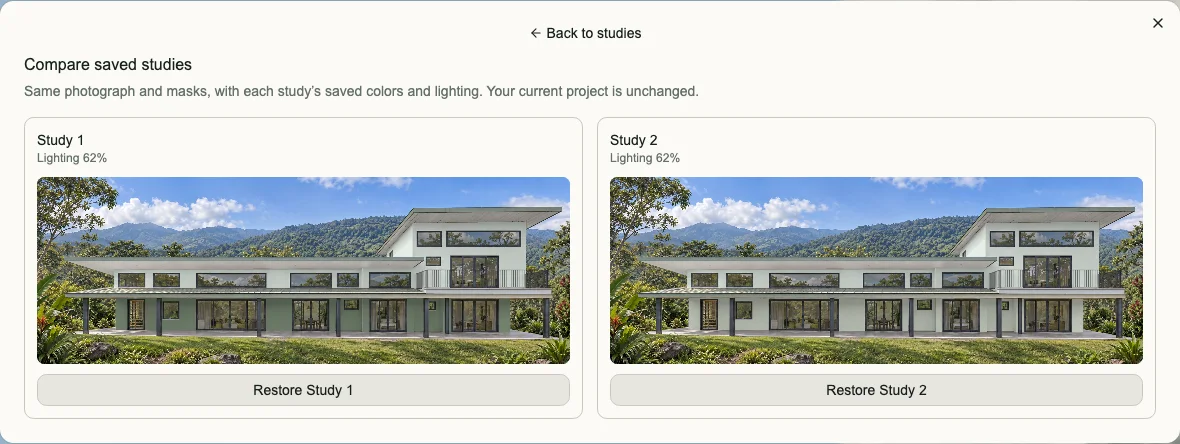
Three clearly different concepts are usually more useful than ten close variations. Each concept should be a complete wall, trim, door, and accent scheme shown on the same house view. Explain the idea behind each direction and how it responds to fixed materials.
A controlled visualizer lets you preserve surface boundaries while changing the color assignments. That consistency helps clients compare the schemes rather than being distracted by different crops, lighting, or architectural details.
- Give each concept a descriptive name rather than “Option 1.”
- Show every option at the same scale and from the same photograph.
- Ask what the client wants to keep and change in one chosen direction.
- Avoid combining unrelated pieces from every concept without checking the complete result.
Turn revision into a bounded service
State in the estimate or consultation agreement how many concepts and revision rounds are included, what counts as a revision, and what additional work costs. A revision should respond to specific feedback such as “reduce trim contrast” or “make the walls warmer,” not restart the entire brief.
After digital comparison narrows the field, move to manufacturer references and physical samples. Screens are not calibrated paint matches. The professional value is the organized decision process: visualization clarifies placement and relationships, while samples confirm the actual coating under site light.
Close with a clear approval record
The final record should identify the approved manufacturer, product line, color name and code, sheen, and assigned surface. Attach the selected concept and note that field samples govern final color acceptance. When the client approves one documented specification, the crew receives a buildable decision instead of a trail of informal messages.